What Are the Advantages of Off-Grid Container Homes Compared to Traditional Homes?

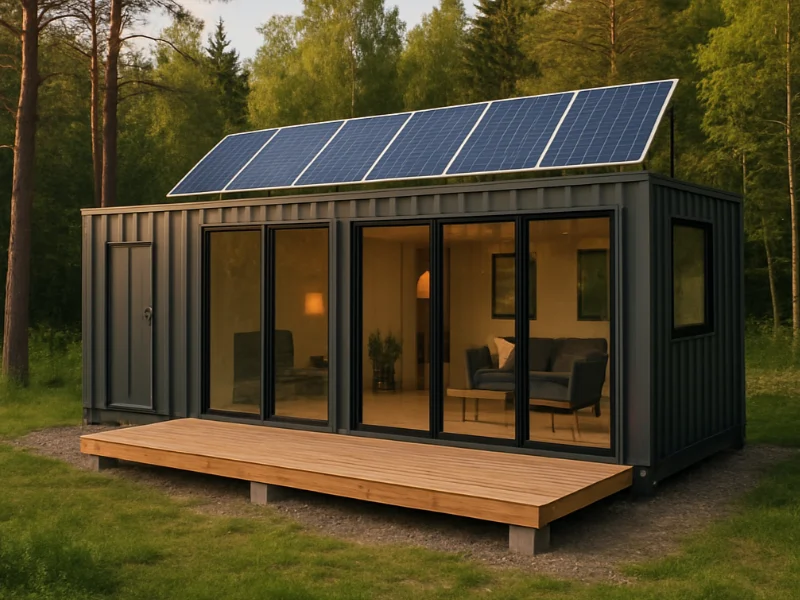
Now picture yourself receiving your monthly electric bill with a hefty sum of $300 dollars. However, if you own one of these off-the-grid container homes, then you will never experience any monthly utility expenses. Instead of having to pay a utility company for life, the owner of such homes buys their independence upfront.
Conventional methods require construction workers to build wooden skeletons bit by bit, thereby making the project susceptible to rainfall and high costs of purchasing lumber. The smart DIY enthusiast can avoid all these complications by beginning with a pre-fabricated steel frame capable of surviving in the middle of the ocean. One could get their hands on a sturdy steel body for as little as $3,000-$5,000 or as much as the price of an old mid-size SUV. Thus, off-the-grid container homes have a structural advantage over regular houses.
Living without utility companies requires a cycle of interdependency within the off-grid community that works similarly to a family bank account. You deposit energy every day with your rooftop solar panels, use your battery arrays as your savings accounts, and withdraw energy every time you flick a light switch or shower.
Statistics indicate that when combined, these sustainable systems together with pre-fabricated metal buildings could save homeowners as much as 30% of the overall cost of home-building than regular neighborhoods. Living without utility companies in a hurricane-proof structure completely changes the laws of owning a house.
From Cargo to Castle: How Repurposed Steel Is Tougher & Quicker Than Average Wooden Framing
Wooden framing is an age-old standard of building construction; yet, sometimes, it turns out to be very fragile under stormy conditions. With container homes, on the other hand, you will benefit from the robust structure that has successfully carried cargo across the Atlantic Ocean. The structural load-bearing capacity that such containers offer exceeds even that of conventional wood 2×4 studs by miles, making such structures resistant to wind speed of up to 100 mph without any bends.
It will take little effort to extend your square footage with these units since their intermodal design makes them globally compatible pieces of steel, easily combinable like Lego blocks. As a result, you’ll be able to place a second-story extension right where you need it without any hassle.
For starters, however, an average 4,000-pound empty unit needs to be supported by a solid foundation made of concrete. Afterwards, it takes you 15 years to give the steel a proper protection against rust through a routine preventive maintenance program.
With the bulk of the most complex framing performed in the factory where the container was originally built, you won’t have much to worry about. Instead, you’ll find yourself saving half of the nine months usually required to complete the entire construction process of a regular house.
Get Your Project Finished 50% Quicker With Modular Assembly: Shipping Container Vs. 9 Months To Traditional Builds
The difference between ordering a prefabricated box and having to put up traditional wooden framing makes an enormous difference in the overall timeline of your build. Rather than waiting several weeks while your frame goes up on site, containers arrive completely assembled, giving you plenty of extra time to customize. By arranging your windows and doors at an off-site fabrication center, you’ll cut out major bottlenecks while having your lot cleared and prepped.
Achieving weather-tight status, allowing you to begin installing electrical systems in a protected environment, becomes a near instant process. With waterproofing already in place before arrival, the timelines become:
Foundations & Preparation: Concurrent (Container) vs. Sequential (Traditional)
Framing: 0 days (Already framed) vs. 21+ days (Traditional)
Weather-Proofing: 1-2 days (Container) vs. 14+ days (Traditional)
In order to fully capitalize on the massive savings in time, make sure to get your permits processed on site while your boxes are under fabrication off site. Maximizing your speed will help you get settled into your new home much quicker, and leave plenty of time to consider how you might utilize the unique properties of modular containers to expand in the future. However, knowing how to budget container material costs vs. conventional framing materials can help you save even more.
The Truth about Cost Per Square Foot: Why Using Containers Will Help You Save 30% on Materials But You Will Have to Work Hard
It is not difficult to understand what makes steel houses so financially attractive when looking at the facts. Comparing the cost per square foot container vs regular homes, we find that you will have to pay approximately $100 for each square foot of container compared to $150 or even more per square foot of conventional timber house. This 30% discount results purely from the purchase of the wall, floor and roof structures in one extremely affordable kit.
In order to get the maximum profit from this deal, you should be careful when picking the type of construction material. Despite the fact that some buyers are eager to save as much money as possible by using used containers, it is much better to go for the “one-trip” version of this structure. These containers are used for transatlantic voyages only once and come practically new, being free of deep structural corrosion that will later require extensive welding work.
One more peculiarity you should take into account when planning a budget for construction is related to the logistics involved in such project. The so-called Crane Day can be considered as one-time significant expense, which will include renting of specialized equipment for lowering your home onto the foundation. Luckily enough, since these types of dwelling houses are becoming increasingly popular, financing alternative homes has become easier than ever before.
When all these operations are done, you will have to protect yourself from the extreme external temperature fluctuations.
Thermal Bridging – Turning a Metal Box into an Ice Chest: How to Insulate Correctly
Putting a metal bar in the wall of the most efficient cooler is the best illustration of thermal bridging. Your ice will melt quickly because the warmth will travel down through that bar. Without any drastic actions taken, your metal box will behave just like the bar, letting freezing drafts and hot air inside of your home.
This process brings a new unseen problem to your household: condensation. Cold metal causes indoor air to condense in the areas where it makes contact. While the result would be mold in the wooden building, the same moisture leads to rust formation, damaging your steel box without giving you much warning.
The only thing capable of preventing condensation is an absolutely perfect seal of insulation. The most advanced choice for such an operation is closed-cell spray foam insulation, which has been recognized as the best material available for insulating homes made from steel containers. This method differs from the classic one in that it is applied as a solid material filling up the whole surface of corrugated steel.
It will be important to create a high level of insulation, measured by R-value, which is the usual energy efficiency rating. Getting to the level of R-21 is a necessary step towards a perfectly regulated interior while consuming little energy. Once this is done, you can be confident and switch to gathering your freedom.
Freedom Harvesting: Constructing Self-Sufficient Water and Solar Systems without Main City Utility
It will be necessary to establish a micro-grid to operate off-grid safely and efficiently. Operating lights, computers, and fridges entails learning amp-hour budgeting, i.e., matching daily production and consumption so as not to overdraw your system.
For this, it will be essential to integrate the following elements smoothly in order to build a localized power plant:
- Solar panels (sources of energy)
- Charge controllers (controllers protecting the battery from overcharging)
- Deep-cycle batteries (secure storage places for energy)
- Inverters (changing stored energy into home-compatible one)
Water safety will be just as important and entail developing self-reliant skills in the sphere known as “The Math of Steel”. An average 40-foot steel container gives 320 square feet, implying that just an inch of rain gives 200 gallons of usable water for independent water harvesting systems. Capturing heavy precipitation into a cistern gives enough freshwater to live comfortably.
Once that harvested water goes down the drain, it will be essential to separate two streams of water – grey and black. The first term implies reusable runoff from sinks and showers; blackwater, on the other hand, denotes toxic waste from the toilet needing composting treatment. Utilization of greywater recycling techniques in sustainable building permits irrigation of the landscape with shower water.
Carbon Mathematics: How Repurposing a 4,000lb Steel Box Will Save You Much More Than Energy Bills
When evaluating if a certain home is environmentally friendly, people usually refer to its electricity costs. However, it is important to understand that the raw materials used in construction possess significant ecological value. Recycling an old cargo ship into a new house represents upcycling or reuse of waste products to create highly valuable items. The standard steel 40 ft container consists of around 8,000 lbs of steel, which would weigh about two medium size SUVs. In other words, recycling allows keeping the high amount of fuel and heat energy necessary to melt the steel.
Using fresh lumber for construction causes considerable damage to the environment. When comparing the carbon emissions generated through recycling of used steel ships and construction using new timber, ecological considerations favor steel much more than wood. In fact, if the steel frame is already available, there is no need for using any machinery to obtain timber logs to build a regular wooden home.
Due to the rust-proof properties of the marine grade steel used to manufacture the structure, these homes could withstand for 50 years or even more without the problems associated with wooden frames. The structures made of used shipping containers are environmentally sustainable and entirely recyclable in the future. However, before inhabiting this eco-friendly shelter, one needs to get the necessary permits from the local authorities.
Dealing With the ‘Red Tape’: Zoning and Financing Discrepancies Between Container and Stick-Built Houses
Getting attached to the idea of living in a steel house is easy, but gaining official permission becomes a challenge, as zoning laws rarely mention container structures. In order to start occupying your steel residence, a Certificate of Occupancy must be provided as evidence that your place is suitable. The best strategy for obtaining it is building a permanent structure as the main requirement for getting an occupancy permit that bridges the gap between permit procedures for tiny and conventional houses.
Traditional banks don’t like unexpected risks and thus don’t usually issue a loan for such a non-conventional structure. Financial institutions compare your property with other buildings in the area to determine its value. There are no comparable properties since off-grid homes are not typical. Instead of trying to get your head around non-existent appraisals, it’s recommended to obtain special construction loans, personal financing lines, or special deals from local credit unions for unusual constructions.
The most important information you should ask the building department about includes:
- Is there any minimum square footage restriction regarding residences in this zone?
- Are there limitations regarding unconventional appearances such as corrugated steel exterior?
- What kinds of off-the-grid sanitation facilities are considered appropriate here?
By passing these steps, you can demonstrate that your project is possible, which means you are ready to switch to a new type of housing arrangement.
Your Journey: From Old-Time Renter to Off-Grid Container Home Owner
Turning tough steel containers into off-grid container homes guarantees full lifestyle independence. Through the efficient process of securing land, obtaining shells, designing the system, and finally moving in, you escape the conventional mortgage pitfall. Your journey allows you to save 30% in initial costs and 50% in construction time compared to conventional building.
Imagine the steel container as the means of transport to your dream of sustainable living. The only thing you have to do is manage three key systems well: water management, energy generation, and thermal insulation. If you use these sustainable building blocks efficiently, you set yourself up for drastically reducing monthly expenditures.
Begin your journey now by reaching out to shipping container homes company such as HighJoule for a quote. Every conversation gives you confidence and moves you a step closer to your self-sufficient living space.


